1. Newton's Law of Cooling
Variables:
- \( T \): Object's temperature
- \( t \): Time
- \( A \): Ambient temperature
The rate of change of temperature is proportional to the difference between ambient temperature and the object's temperature: \[ \frac{dT}{dt} \propto (A - T) \longrightarrow \frac{dT}{dt} = k(A - T) \] Where \( k > 0 \).
Observations:
- If \( T < A \), then \( T' > 0 \) (The object warms up).
- If \( T = A \), then \( T' = 0 \) (Thermal equilibrium).
- If \( T > A \), then \( T' < 0 \) (The object cools).
2. General and Particular Solutions
If an Ordinary Differential Equation (ODE) is in the form \( y' = f(x) \), the general solution is found via integration: \( y = \int f(x) dx + C \).
Example 1: Basic Integration
Find the general solution for \( y' = 2x + 3 \):
\[ \int dy = \int (2x + 3) dx \] \[ y + c_1 = x^2 + 3x + c_2 \] \[ y = x^2 + 3x + C \quad \text{(General Solution)} \]Find the particular solution given the initial value \( y(1) = 2 \):
\[ 2 = (1)^2 + 3(1) + C \] \[ 2 = 4 + C \implies C = -2 \] \[ y = x^2 + 3x - 2 \quad \text{(Particular Solution/Solution to IVP)} \]Example 2: Inverse Trigonometric Form
Find the general solution for \( \{y' = \frac{12}{x^2 + 16}\} \):
Recall: \( \frac{d}{dx}[\tan^{-1}(\frac{x}{a})] = \frac{a}{x^2 + a^2} \)
\[ \frac{dy}{dx} = 3 \cdot \frac{4}{x^2 + 4^2} \] \[ y = 3\tan^{-1}\left(\frac{x}{4}\right) + C \]Find the particular solution for \( y(0) = 1 \):
\[ 1 = 3\tan^{-1}(0) + C \longrightarrow 1 = C \] \[ y = 3\tan^{-1}\left(\frac{x}{4}\right) + 1 \]3. Acceleration, Velocity, and Position
For constant acceleration \( a(t) = x''(t) = 7 \):
- Integrate once for velocity: \( v(t) = x'(t) = 7t + C_1 \)
- Integrate again for position: \( x(t) = \frac{7}{2}t^2 + C_1t + C_2 \)
Note: A 2nd order ODE general solution contains two unknown constants. These correspond to physical initial conditions:
- \( C_1 = v(0) = v_0 \) (Initial velocity)
- \( C_2 = x(0) = x_0 \) (Initial position)
4. Modeling an ODE from Geometric Properties
Problem: Write an ODE for \( y(x) \) such that the tangent line at \( (x, y) \) passes through the point \( (-y, x) \).
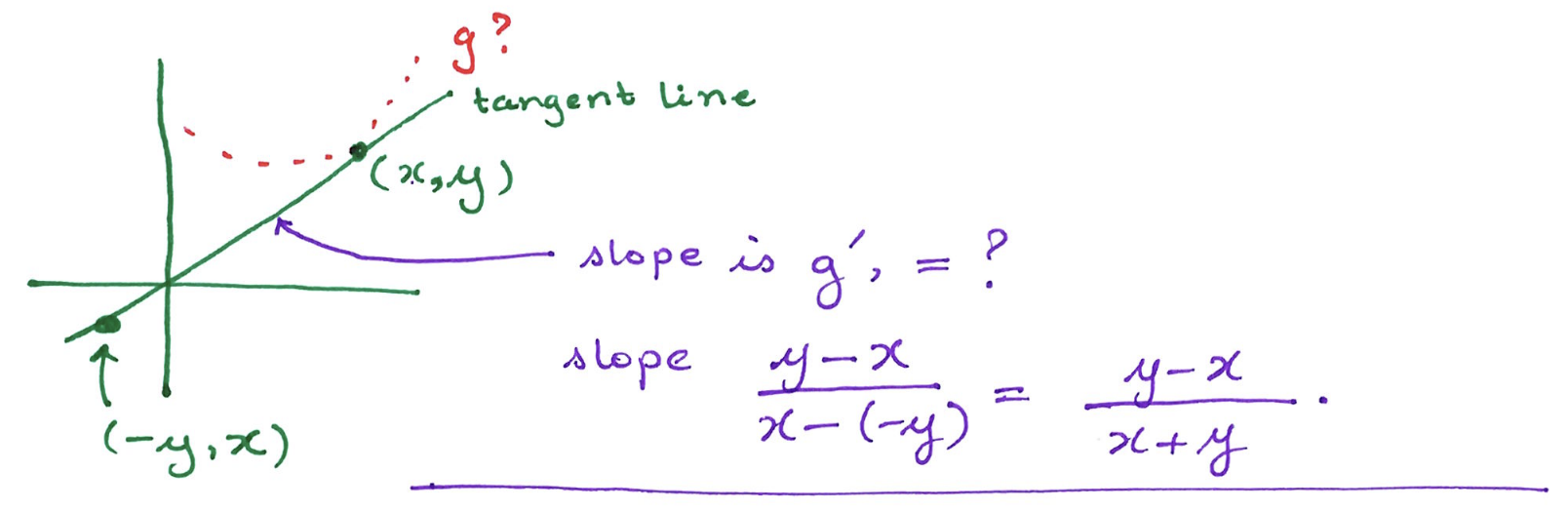
The slope of the tangent line \( y' \) is determined by the two points \( (x, y) \) and \( (-y, x) \):
\[ \text{slope} = \frac{\Delta y}{\Delta x} = \frac{y - x}{x - (-y)} = \frac{y - x}{x + y} \]Therefore, the ODE is:
\[ \frac{dy}{dx} = \frac{y - x}{x + y} \]